

Non-Initiated Change
Management of Change: Overt and Covert
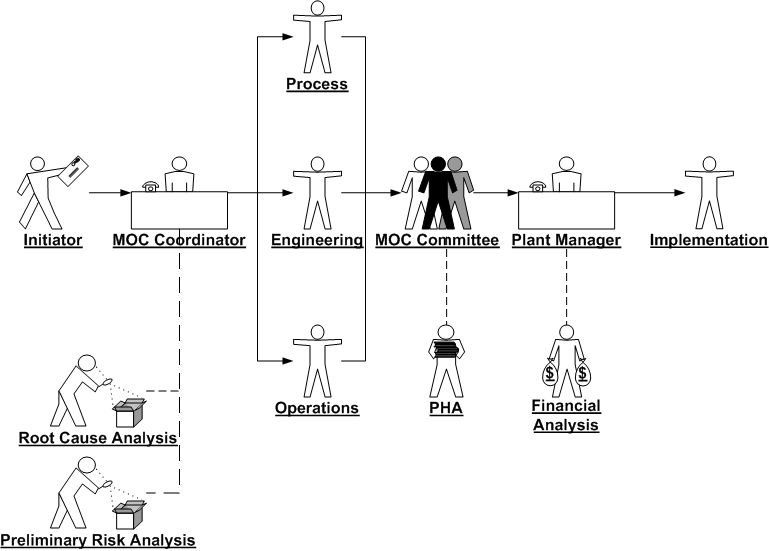
Discussions to do with Management of Change generally assume that someone has consciously decided to change a system. But this assumption can be misleading.
Some changes are ‘non-initiated’, i.e., they are not the consequence of an explicit action. Corrosion is a common example of this type of change; a vessel or a pipe may be gradually losing wall thickness due to corrosion without anyone knowing until the item fails catastrophically.
Increasing production rates can also lead to non-initiated change; as management gradually sets ever higher target values, the facility, its equipment and its people are pushed to their limits: flows, temperatures and pressures are all increased. Even if no specific safe limit is exceeded, the increased severity of operating conditions could lead to a failure.
Non-initiated changes are difficult to control with a Management of Change program because no one knows about them until an it is too late. Instead, changes of this type are controlled by other elements of the risk management program such as Asset Integrity, Process Hazards Analysis and Incident Investigation.
Overt or Covert
Non-initiated changes can be Overt or Covert.